
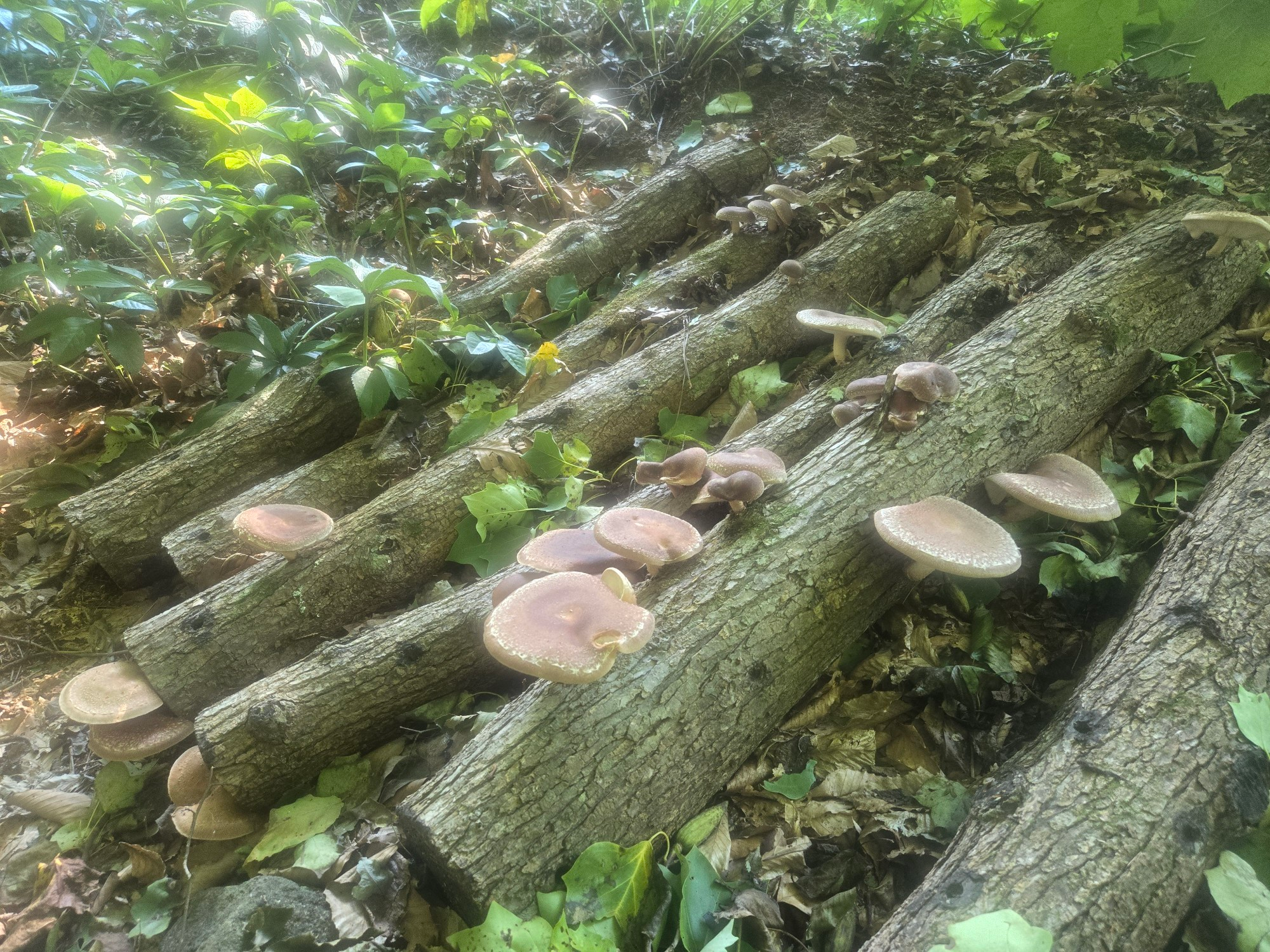
You can grow fresh shiitake mushrooms right at home. This article shows how-to grow shiitakes on sweetgum tree logs. Learn how to select perfect logs and when to cut them, purchasing mushroom spawn and necessary tools, inoculating logs, and site selection tips for awesome mushroom production.
But why American sweetgum trees? Over the years my husband and I have tried to find a purpose for the hardy, prolific American sweetgum tree (Liquidambar styraciflua). They could make a decent shade tree, if it weren’t for the balls.
The fruit they make, known as sweetgum balls, is such a nuisance. Without fail those prickly ball-bearings plague driveways, patios, and lawns every year. They make pets and people miserable, causing soar paws and twisted ankles.

Not only that, sweetgum balls cling to lawns and aren’t easily removed. The balls rain down from December to April. Ouch!
Sweetgum trees don’t make good firewood, due to the fact that the wood doesn’t split but twists and shreds apart. Stacking a neat pile of sweetgum firewood is impossible, with all the odd angles and such. I’ve seen folks try to make decorative wreaths out of the little prickle balls. Not for me. Then I stumbled upon growing fresh shiitake mushrooms on logs. Yes!!!
Sweetgum Trees: Choosing Candidates
If you live in the Appalachian piedmont, you may already have numerous trees on your property that will be good for shiitake mushroom logs. For instance, beside the sweetgum, all species of oak tree work great, followed by beech, hickory and maple. I can’t bring myself to cut down an oak or maple, since they are so beautiful and valuable to wildlife.
But as it happens, the sweetgum produces amazing fresh shiitake mushrooms! The heartwood to sapwood ratio is just right for shiitakes. Based upon the latest research, here are our favorite recommendations for logs.
Punch List for Tree Logs:
- Timing is everything, so don’t just gather up a bunch of random logs from the forest floor. Cut trees down from January to February, before the sap starts to run.
- Choose trees that are alive and healthy and will produce logs that are 4″ to 8″ diameter.
- Also, choose trees that will produce straight logs and that have undamaged, tight bark.
- Know how to cut and drop a large tree safely.
- Cut down the tree and leave the entire fresh-cut tree whole, with branches on it, for 10 days. This helps normalize the water within the tree, so it doesn’t bleed and lose internal moisture.
- After 10-days, remove small branches and cut logs into 4′ lengths, choosing limbs and trunk areas that are straight. Keep log selections in the 4″ to 8″ diameter range.
- While cutting and handling, be careful not to damage the bark further.
- Stack logs horizontally off the ground till you are ready to inoculate them.
- Maintain internal moisture of logs. For instance, if the weather is dry and windy, drape wet burlap over the logs. Conversely, in rainy weather, don’t leave logs lying on water-puddled ground.
- Inoculate logs with mushroom spawn within 30-days.
Failing to follow the above log guidelines will reduce mushroom production.
Mushroom Spawn and Necessary Tools
By the way, a mushroom is actually the fruiting part of the fungus. Spawn is a mixture of mycelium and sawdust. The mycelium is the white, thready network of the fungus. Inoculation is the process where the spawn is inserted into a log. Spawn run or incubation refers to the 6-month to 1 year+ period when the mycelium is growing throughout the log, consuming carbohydrates in preparation to make fruit.
Mushroom Spawn
Order the spawn at least a couple weeks before you cut trees and keep it stored in the frig till you’re ready to inoculate. There are many online sources for spawn, like Field & Forest Products.
Shiitake mushroom cultivars can be warm season growers, cold season growers, or wide range. My go-to cultivar is ‘Snowcap’, which is a cold season cultivar that produces fruit sporadically in fall, winter, and spring, depending on the weather that year. I’ve had ‘Snowcap’ in January! That will extend the productivity of a food forest for sure!
I have also used the warm season cultivar ‘Aloha’, which produces fruit sporadically in spring-summer-fall, again depending on the weather that year. Both types are beautiful and delicious.
Shiitake spawn is sold either in loose sawdust, or in hardwood plugs. I use the sawdust and will describe the tools needed for that, since sawdust is more commonly used.
Necessary Tools for Sawdust Spawn
If you purchase inoculating tools from a single mushroom supplier, it’s easier. They describe how to use their products and may even provide a full kit to get you started. That’s what I did. Find the inoculating tools and matching drill bits, wax, wax daubers and more all in one place. You will still need to have a drill, something to heat the wax with, and worktables or sawhorses.

The wax, palm-style inoculator (what I use), wax daubers and 12.5mm bit with stop are great supplies to order in advance.

We use an old metal bucket to heat the wax along with a Coleman camping stove. Add in the drill, lighter and sawhorses to complete the supplies.
Inoculating Logs for Fresh Shiitake Mushrooms
Since I’m growing fresh shiitake mushrooms just for my family, I order a 2.5 lb bag of shiitake sawdust and have a quantity of about 12 logs, 4′ in length, cut and ready to use. Every other year I do a fresh batch, and will have three generations of logs producing mushrooms, which is way too much actually. Logs will keep producing mushrooms for 3-8 years. It takes 3 hours of steady work from both me and my husband (6 manhours total) to finish inoculating the 12 logs.
What We Do
We place logs on sawhorses and drill holes using the specially designed 12.5mm bit with stop. This insures the proper diameter and depth of the holes. Holes are spaced all around the logs approximately 5″-6″ apart.

After drilling, we jab the palm inoculator a few times into the sawdust to stuff it full. Then we carefully align the tip of the inoculator with each hole and smack the plunging knob, which packs the sawdust into the hole. My palm gets soar after several whacks, so I use a rubber mallet.

Then we daub hot, melted wax on each sawdust-filled hole and paint both ends of the logs with wax, too. Careful sealing with wax will help the logs hold moisture.

Afterwards, we cart logs to the production area and stack them up tightly during spawn run.
During dry spells we drape a mesh shade cloth over the pile (or you could use burlap) and give it a good watering. This will keep the humidity up and give time for the moisture to move into the log.
This photo shows a low crib stack of 2-year-old logs with quite a bit of sunlight peeking through the trees in winter.
After 6 years of fresh shiitake mushroom production, retired logs are used to hold-up steep slopes and provide a sort-of bark mulch that the chickens can’t claw-up. Our chickens fling bark mulch and pine needles everywhere in their quest for yummy seeds and bugs. So messy. Even though the retired mushroom logs are starting to get soft and punky, their bark still clings to the log. Chickens can’t kick it around! This is great for areas where I’m trying to prevent erosion and want to keep the ground covered.
Site Selection, Stacking and Maintenance
Site Selection
Site selection is typically under the shade of trees. Dappled shade to light shade, or about 75% shade, is best. Deep shade, 100% shade, is too much, so under a deck might not work at all.

In the winter, sunlight reaches the logs easily. But by summer, leaves block-out nearly all direct sunlight. Even so, the area is still bright enough to photograph.
This photo shows my “retired” logs holding up a sloping bank. I couldn’t believe all the mushrooms they still make!
Another thing to consider, choose a site that is within reach of a garden hose. Remember that there will be times during dry weather when the logs benefit from a good soak.
Lastly, it helps if the site is level to prevent the logs from rolling as you stack them.
Stacking
While logs are incubating, they are stacked closely, often in a low crib. I keep mine near the ground in a single row, which takes advantage of dew and reduces evaporation from wind.
As harvest time nears, many folks restack them in either a high crib stack or more vertically in a lean-to fashion. While crib stacking saves space, lean-to style makes harvesting easier. In spring and fall, shiitakes produce a bumper crop, followed by a couple smaller batches. Sometimes it’s hard to tell when they will rest. If you keep them in a crib stack for long, the logs on top dry out more quickly. At the same time, logs on the bottom of the crib are too shaded and should be periodically moved to the top.
With the crib method, I found myself unstacking and restacking constantly, which was too much work. Now, as mentioned before, I keep them in a single row, elevated 2″-4″ off the ground, during incubation. At harvest, one end is tipped up to 18″ off the ground.
There are many videos online that emphasize one thing or another to grow shiitake mushrooms on logs. I really enjoy watching how others do it, so much great advice! Decide which site location or stacking method will work best for you.
When mushrooms are ready to make fruit, little buttons (or pins) called primordia will start to emerge. The primordia stage always occurs when I’m out of town for the week, Murphy’s Law. My mushrooms will grow from little buttons to picking perfection within 5 days.
After the excitement ends, return logs to their resting position.
Enjoying this article so far?
Mash that subscribe button and never miss a post.
Maintenance
Logs benefit from regular rainfall during the summer months. Overhanging leaves from trees prevents some rainfall from reaching the logs. Keep a shallow pan (or rain gauge) near the logs to determine how much rain actually falls on them. 1″ of rainfall per week should do in summer.
If rainfall is absent, provide extra water by draping a mesh shade cloth (or burlap) over the logs and soak with a sprinkler for 15 minutes or so. Leave the mesh draped over the logs for a few days, soaking again if the mesh dries out. This is especially for the cold season cultivars which are incubating during the summer. Conversely, warm weather cultivars are making shrooms, so draping logs with mesh/burlap could damage your harvest. Just use a sprinkler and water the warm weather cultivars for about an hour between harvests in summer.
During the coldest winter months, there is less evaporation and watering isn’t as critical. For the most part, nature seems to take care of things in winter. Also, for warm weather cultivars, fall leaves can be used to hold moisture around your logs while they incubate in winter.
Unlike sweetgum trees, beech trees and other thin barked trees loose water more quickly. Adjust watering needs to fit the trees you use.
When mushrooms start to grow big, rainfall is bad news.
While the little buttons (pins) won’t be adversely affected, keep the rain off of the logs while the mushrooms are nearing full harvest size. Not so easy to do sometimes. I’ve discarded an untold number of soggy mushrooms by not paying attention to the weather. A quick afternoon shower doesn’t affect them much, but an all-day rain will. Soggy mushrooms aren’t good to eat; you want them dry to the touch. I have a tarp now that I can secure overhead quickly to keep rain off, sort of like a tent fly.
I can’t speak for a large scale or commercial production, since I just dabble. Production can get much more complicated. If you want to explore making a profitable mushroom business, check out local universities for more information on shiitake mushroom production. Both NC State and University of Kentucky delve deeply into the subject, including information about determining and maintaining moisture content of logs.
Harvesting and Storing
Logs will produce fruit naturally as the seasonal temperature changes.
Mushrooms are ready to harvest when the cap is mostly uncurled with just a little turn-under along the edge. If they are flattened all the way out and splitting, they are considered past their prime. Cut the mushroom off at the base with a sharp knife, rather than pulling them. Gently brush off loose dirt and bark.
Bugs and Slugs
Winter fruiting mushrooms will have fewer bugs and slugs to deal with but will still occasionally get them. Slugs love mushrooms. I discover them hiding just within the curl of the cap, darn things. Just pick the slugs off while harvesting mushrooms. If slugs get to be a problem, positioned logs over gravel instead of leaves or mulch. You can also sprinkle lime dust or ash on the ground to keep slugs from creeping near your logs.
Little black midges of some sort play hide-and-seek in the gills. Blow away midges using an air compressor or just tap the mushroom cap on the countertop to knock most of them out, before storing mushrooms in the frig.
Don’t wash the mushrooms. They need to remain dry. You can give them a quick rinse right before eating them.
Storing
Fresh shiitake mushrooms can be stored, unwashed, in a paper sack in the refrigerator for a few days. The sooner they’re eaten, the better the texture. The frig dries them out a bit, and they start to shrivel slightly and harden. The gills turn from creamy white to dingy beige, too. I toss them before they get too ugly. If the mushrooms start to look wet, definitely throw them out.
With way too many mushrooms to eat fresh, I turn to dehydrating for long term storage. I remove the stems at this time, since they aren’t really edible, but I keep the gills on. Food dehydrators can be found online. I slice them then dehydrate them till they are dry and snap like a chip. Use a FoodSaver to vacuum seal them in small packs that match your cooking needs and store them in the frig for up to a year.
Dried shiitake rehydrate quickly in hot soups and marinara sauce, adding extra protein. They have a slightly chewy texture, kind of like clam strips, so I crumble them up into smaller pieces. Even when dehydrated, the earthy, umami flavor they provide is unmistakable.


Leave a Reply